
This article provides general business and accounting information. Examples are illustrative. Actual accounting, tax, legal and compliance treatment depends on the facts, entity type and provisions applicable to the relevant period.
Your current outlet is busy, and a promising property becomes available. It is tempting to begin with interiors, equipment and a launch date.
A successful existing outlet does not automatically make a new branch viable. Before committing, ask whether the proposed branch can support its own costs and how much cash the existing business can afford to put at risk.
Begin with the economics of one branch
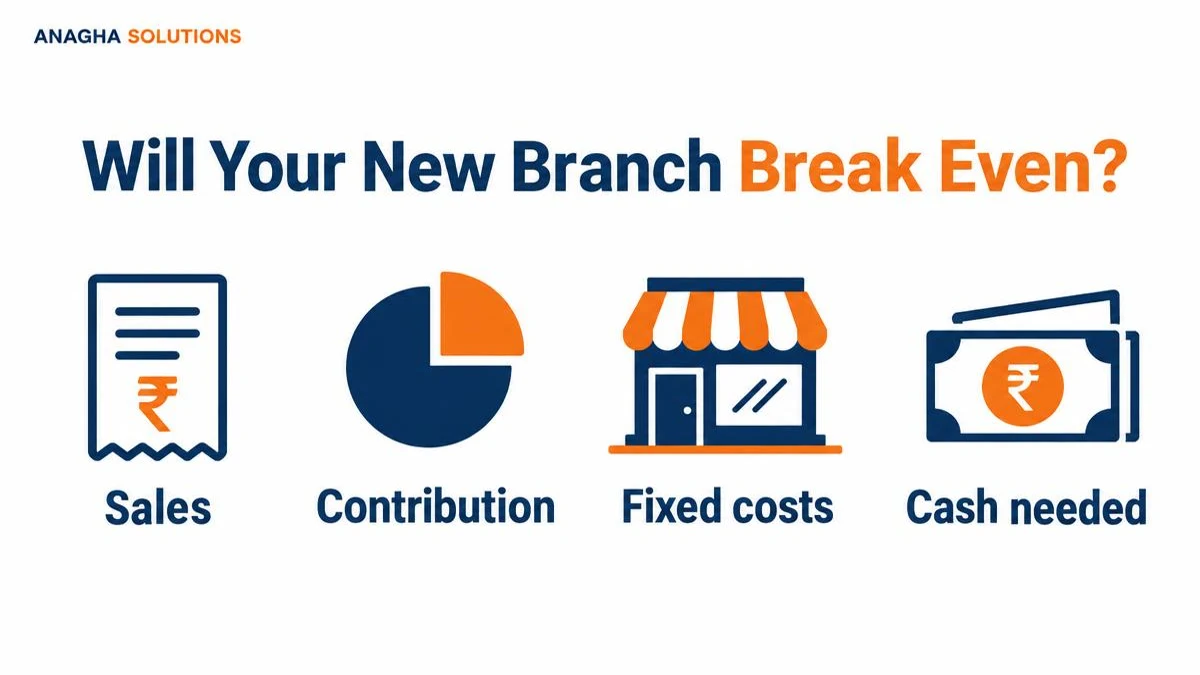
Estimate net sales after returns and discounts, then deduct variable costs that move with sales to find contribution. Contribution covers relevant fixed operating costs; what remains is the result under the model's stated exclusions, not automatically final net profit. Include branch rent, fixed staffing, utilities, maintenance, software and recurring local costs; classify each cost consistently rather than treating every expense as variable.
Show additional head-office costs caused by expansion separately from an allocation of existing shared costs. For this example, ₹2,00,000 includes all relevant branch fixed operating costs and any additional central support costs; no allocation of unchanged existing head-office costs is included. Where useful, show a separate result after that allocation without counting the same central cost twice. Check the consolidated impact, not only the branch result.
Use net sales and costs excluding recoverable GST; include non-recoverable taxes in the relevant expense or asset cost as appropriate. Cash timing may still include tax amounts and recovery delays. Actual eligibility and tax treatment need separate assessment; this is an accounting explanation, not tax guidance.
Work through a simple threshold
In an original fictional example, a branch has a 40% contribution margin and ₹2,00,000 monthly fixed operating costs. Its operating break-even sales would be ₹5,00,000 a month: ₹2,00,000 divided by 40%.
Break-even sales = relevant fixed costs ÷ contribution margin ratio. Here variable costs are 60% of sales and contribution is 40%. The relationship assumes reasonably stable pricing, variable-cost ratio and sales mix within the relevant capacity range. A staffing or capacity step-change can alter fixed costs.
| Measure | Base case | Slower-sales case |
|---|---|---|
| Net sales | ₹5,00,000 | ₹4,00,000 |
| Variable costs (60%) | ₹3,00,000 | ₹2,40,000 |
| Contribution (40%) | ₹2,00,000 | ₹1,60,000 |
| Relevant fixed operating costs | ₹2,00,000 | ₹2,00,000 |
| Operating result before excluded items | ₹0 | −₹40,000 |
At ₹4,00,000 sales, contribution is ₹1,60,000, leaving a ₹40,000 operating shortfall. Both results exclude depreciation, interest, tax and any other adjustments not included above; neither is final net profit or available cash. Operating break-even does not mean the initial investment has been recovered. If fixed costs separately rise to ₹2,20,000 at the same 40% margin, break-even sales become ₹5,50,000; this is a separate sensitivity, not the table's slower-sales case. No calculation promises profitability or justifies expansion on its own.
Profitability is only one part of readiness
Separate the initial cash requirement into: (1) refundable security deposit; (2) fit-out, equipment and other capital expenditure; (3) pre-opening expenses such as recruitment and training; (4) opening inventory where applicable; (5) additional working capital and funding for early operating shortfalls; and (6) a contingency allowance based on identified risks. A refundable deposit still ties up cash, even though it is not an ordinary monthly expense.
Build a dated cash schedule for payments, customer receipts and supplier terms. Count opening stock once: if shown separately, include only further inventory needs in working capital. Do not add pre-opening expenses again to operating costs, or fund the same operating shortfall in both working capital and a separate reserve. Identify the timing and amount of each cash gap before adding a risk-based contingency; there is no universal number of months of reserve suitable for every branch.
Test sales using location-specific footfall or enquiry volume, conversion rate, average transaction value and trading days. Check capacity, staffing, seasonality and ramp-up time. The base and slower-sales figures above are fictional assumptions to test, not forecasts. Model lower margins, higher costs and delayed receipts too; an operating loss is not a complete cash-shortfall estimate.
Consider whether the branch could divert sales, staff, stock or management attention from the existing business. Check whether that business can still pay its own staff, suppliers and obligations if the new branch needs support for longer than expected. Identify funding availability and its cost without assuming a loan will be approved.
Before signing the lease, check: location suitability and permitted use; relevant approvals and operational feasibility; rent, escalation, deposit and lock-in commitments; fit-out period and opening timeline; exit obligations and restoration costs; funding availability; and responsibility for managing and monitoring the branch, including reporting and stock/cash controls. This due-diligence checklist does not replace location-specific legal, licensing or technical review. One existing registration should not be assumed to cover every new location.
Agree a review date and practical actions for underperformance before the launch. Expansion is easier to manage when there is a plan for disappointing months as well as successful ones.
For the wider distinction between profit and funding needs, read Sales Are Growing. Why Is There Still No Cash in the Bank?
Editorial context & sources
The ICMAI Management Accounting study notes provide background on contribution and break-even analysis. The assumptions, examples and readiness checks in this article are original editorial illustrations.
Source references are provided for educational context and do not imply review or endorsement by the referenced institution.
Before committing to a new location, discuss a branch viability and cash-flow review with Anagha Solutions.
Discuss with Anagha SolutionsDiscuss your requirements
Please do not share passwords, OTPs, bank credentials or sensitive financial documents.