
This article provides general business and accounting information. Examples are illustrative. Actual accounting, tax, legal and compliance treatment depends on the facts, entity type and provisions applicable to the relevant period.
A customer asks for five per cent off. It sounds manageable, especially when the order is large or a competitor is quoting less.
Before agreeing, calculate what that discount removes from the amount available to cover fixed costs and profit.
Work with contribution, not just turnover
For this simplified decision, contribution per unit is the selling price less variable costs per unit. It is not net profit: rent, fixed salaries and other fixed costs still need to be covered.
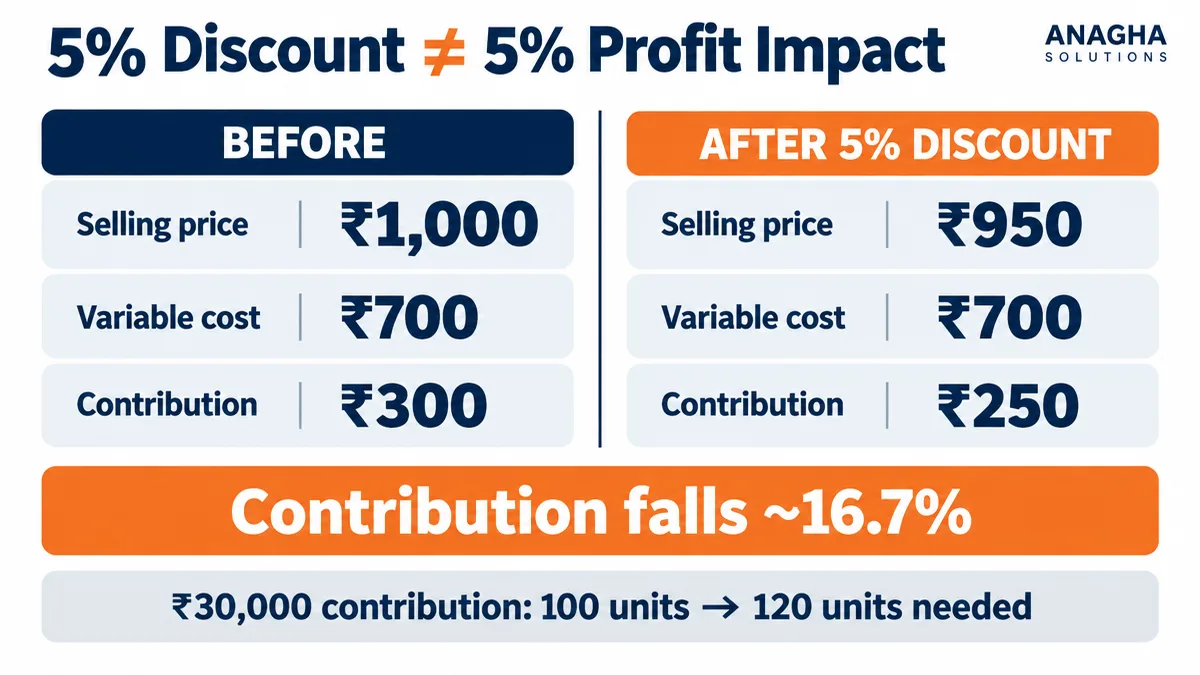
Consider an original fictional example. Your selling price is ₹1,000 and the relevant variable cost is ₹700, excluding recoverable GST and assuming the cost remains unchanged.
| Item | Before discount | After 5% price discount |
|---|---|---|
| Selling price | ₹1,000 | ₹950 |
| Variable cost | ₹700 | ₹700 |
| Contribution | ₹300 | ₹250 |
The ₹50 discount reduces contribution by about 16.7%. To generate the same contribution as 100 units previously produced, you need 120 units at the discounted price: ₹30,000 divided by ₹250.
More volume can bring more costs
The calculation assumes adequate capacity, unchanged variable costs, the same product mix and no additional fixed costs. Real orders may require extra delivery runs, overtime, storage or a new employee. They may also take longer to collect.
Check returns, sales commissions, payment charges and order-specific costs. Include the effect of non-recoverable taxes where relevant. Confirm contractual and tax treatment separately rather than using this example as a GST rule.
Give the team a clear approval process
Define which discounts need approval and which costs must be checked before a quotation is issued. Review contribution per order and total customer profitability, especially where repeated small concessions have become routine.
A discount can be commercially sensible. The useful question is whether the price, volume, collection terms and capacity make the order worthwhile together.
Editorial context & sources
Source: S2 for the foundational contribution concept. All amounts and calculations are original illustrations, not a recommended selling price.
Source references are provided for educational context and do not imply review or endorsement by the referenced institution.
If discounts are increasing but margins are weakening, discuss a costing and pricing review with Anagha Solutions.
Discuss with Anagha SolutionsDiscuss your requirements
Please do not share passwords, OTPs, bank credentials or sensitive financial documents.